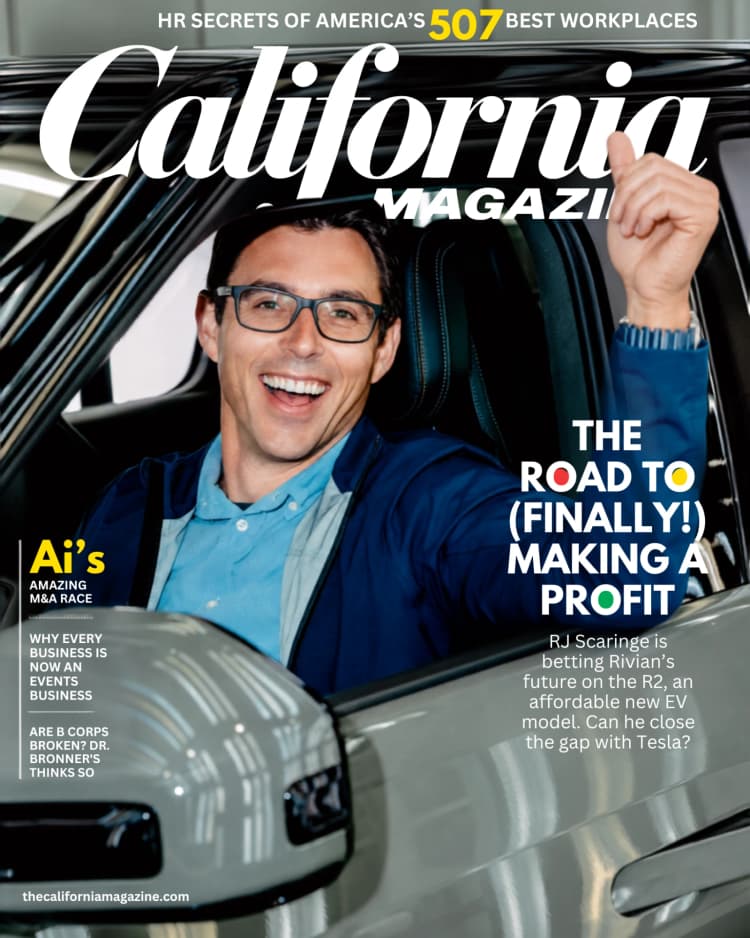
RJ Scaringe's Road to Profit Runs Through the Rivian R2. Can He Close the Gap With Tesla?
RJ Scaringe is betting Rivian's future on the R2. Deliveries have begun on schedule, but the cheap version is a year away and profit is further still.

RJ Scaringe has spent most of his adult life building one company. He founded it in 2009, straight out of a PhD at MIT's Sloan Automotive Lab, spent two years on an electric sports car, and in 2011 pivoted to the adventure trucks and SUVs that became Rivian. Amazon, Ford and Cox Automotive backed him in 2019. In November 2021 Rivian went public at $78 a share, one of the hottest listings of the year.
Five years later the stock closed at $15.23 on September 16, and Scaringe's company is being judged on a single vehicle. The R2, a smaller, cheaper SUV built in Normal, Illinois, is his answer to the question that has hung over Rivian since the IPO: can it sell enough cars, at a low enough cost, to make money, and can it do that while Tesla sells more cheaper cars than ever?
Scaringe has not been shy about the stakes. The R2 is "maybe the most important thing we've launched to date," he told TechCrunch when deliveries began. In the company's second-quarter results he called it "a driver of Rivian's long-term growth and profitability."
The launch arrived on time, with an asterisk on price
Unlike many EV programs, the R2 has broadly kept its schedule. Validation builds began in January, and production started on April 22, days after an EF-1 tornado hit the building that houses the line, Electrek reported. First customer deliveries followed on June 9.
The asterisk is price. The R2 was sold to reservation holders as Rivian's affordable model, starting around $45,000. The only version delivering today is the Performance Launch edition at $57,990, with 330 miles of EPA range and 656 horsepower. A Premium all-wheel-drive trim at $53,990 is due late this year, and a Standard Long Range rear-drive model at $48,490 in early 2027. The entry-level Standard, at about $45,000, is expected in 2027; reports differ on whether it arrives in the first half or late in the year.
That sequencing is common, since early buyers of higher trims help pay for the ramp. But it means the car that was meant to widen Rivian's audience is, for now, priced like the premium product it was supposed to sit below. It also arrives without the $7,500 federal tax credit, which ended for vehicles acquired after September 30, 2025.
Gross profit is not the same as profit
Rivian's latest numbers explain why the "finally profitable" story is not yet true. In the second quarter it delivered 12,194 vehicles, beating its own outlook, and revenue rose 27 percent to $1.66 billion. The company reported a gross profit of $179 million, building on a $144 million gross profit for all of 2025.
Look closer and most of that came from software and services, which earned $215 million in gross profit, including $308 million of revenue from its joint venture with Volkswagen, according to Electrek. The automotive business lost $36 million at the gross level, a large improvement on the $335 million loss a year earlier, helped by $108 million in regulatory credit sales and a tariff refund. Below the gross line, Rivian lost $837 million, and adjusted EBITDA was negative $379 million.
“Rivian's gross profit is real. Most of it comes from software and a partner, not from the cars.”
The longer-term target also moved. In March Rivian said in a filing that it no longer expects adjusted EBITDA to be positive in 2027, citing higher spending on autonomy, and it did not give a new date. Its 2026 guidance calls for adjusted EBITDA of negative $1.8 billion to negative $2 billion.
The money to get there
Scaringe has assembled an unusual set of partners to fund the gap. Volkswagen has committed up to $5.8 billion through RV Tech, a 50-50 joint venture that builds the electrical architecture and software for both companies' vehicles; a milestone in March unlocked another $1 billion. Uber agreed in March to invest up to $1.25 billion and to deploy up to 50,000 autonomous R2 robotaxis, starting with 10,000, with launches in San Francisco and Miami planned for 2028. Amazon now has more than 40,000 Rivian delivery vans on the road.
Rivian also sold about $1.3 billion of new shares in July, leaving pro forma liquidity of $7.16 billion at the end of the second quarter. In Georgia, it cut its Department of Energy loan to $4.5 billion from $6.6 billion while raising the first phase of the planned plant to 300,000 vehicles a year, with production due to start in late 2028.
Can he close the gap with Tesla?
On scale, not soon. Tesla delivered 480,126 vehicles in the second quarter alone, up 25 percent from a year earlier, which Electrek linked to a jump in gasoline prices. Rivian delivered 22,559 in the whole first half, roughly 3 percent of Tesla's volume over the same period. Tesla's Model Y Standard launched last October at $39,990, about $5,000 below where the cheapest R2 is expected to land.
Rivian is not trying to match Tesla unit for unit this year. It is targeting 20,000 to 25,000 R2s within total 2026 deliveries of 65,000 to 70,000, which means the second half has to deliver roughly twice the first. At a Morgan Stanley conference this week Scaringe said the factory is not the constraint. "We can only ramp as fast as our slowest ramping supplier," he said, adding that a second production shift is due by the end of September. Citi started coverage of the stock at neutral this week, citing the ramp.
The comparison Scaringe wants is on product and technology rather than volume. At its Autonomy & AI Day in December 2025, Rivian unveiled an in-house chip and said lidar is coming to future R2s, and it is targeting Level 4 autonomy in 2028. He is also backing two spinouts: Also, a micromobility company that raised a $150 million Series D in August, and Mind Robotics, an industrial robotics startup that has raised more than $1 billion.
What the next six months will show
The R2 has passed its first test: it exists, on schedule, and early demand has been strong enough for Rivian to raise its delivery guidance. The harder tests come next. Suppliers have to keep pace with a second shift, the cheaper trims have to arrive when promised, and the automotive business has to earn a gross profit on its own rather than leaning on credits, refunds and Volkswagen. Rivian will also be doing it with a new finance chief, after CFO Claire McDonough said she will leave at the end of October.
Scaringe calls the R2 "really the mass market vehicle." If he is right, Rivian's path to profit runs through Normal, Illinois, over the next two years. If the ramp slips, the company's partners will once again be what keeps the road open.